
Synchronization
This is the most important page in the Help Center. It explains how the app engine works under the hood.
What is a RAM folder ?
A RAM folder is actually a tmpfs volume mounted into your folder.
tmpfs is a filesystem whose contents live entirely in your Mac’s memory. It is fast and uses only as much RAM as actually used in the volume.
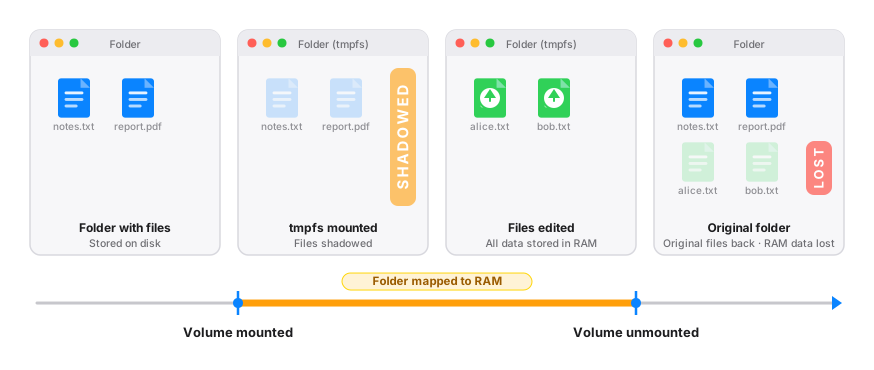
It has an unexpected behavior though: when mounted into a folder, it replaces its contents so that the folder appears empty (it shadows the folder contents), and, when unmounted, throws all the contents away and “un-shadows” the original folder contents.
This is fine for a scratch/temporary directory, but is unusable for a folder you want to keep your data in.
The diagram below explains it visually:
How does RAM Folder solves this ?
To solve this problem:
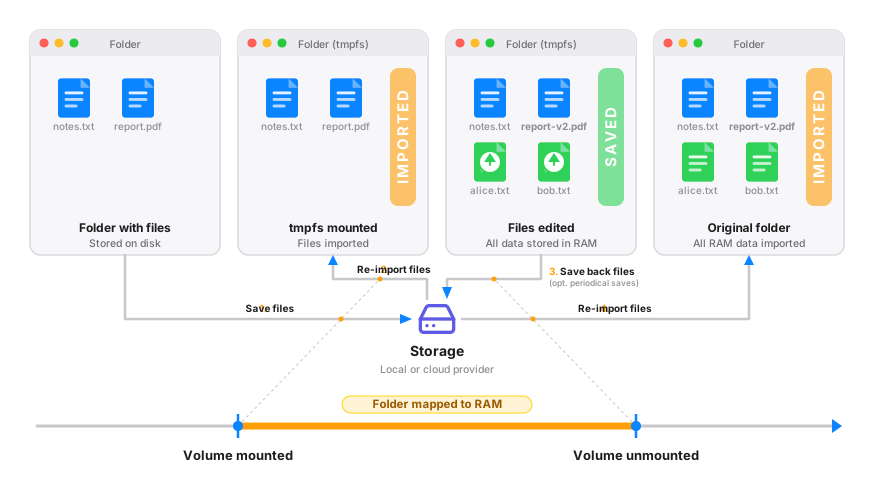
- When mounting a volume, the folder contents is saved to a snapshot folder beforehand.
- Once the tmpfs volume is mounted into the folder, the snapshot contents is imported back into it.
- When unmounting the volume, the tmpfs volume contents is saved back to the snapshot folder beforehand.
- Once the tmpfs volume is unmounted, the snapshot contents is imported back into the original folder
This way, transitionning from normal folder to RAM folder and back is transparent and seamless.
What if I want a temporary folder ?
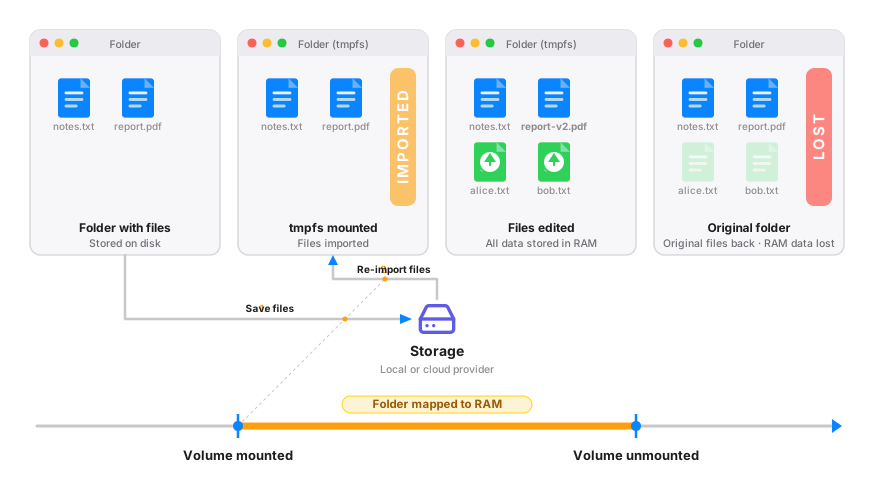
The behavior described above is the default behavior, when the Sync RAM folder option is on. Turn it back off and you get a temporary folder, seeded with the folder contents, but not synced back.
The three copies of your data
The snapshot is the app’s private staging copy. It exists because once the RAM folder is mounted, the SSD folder is hidden — the app needs a place reachable on both sides of the mount boundary to carry data across.
| Copy | Where | Survives eject / reboot? |
|---|---|---|
| RAM | The mount path, while mounted | No |
| Snapshot | Local disk storage (see Data Safety) or Cloud storage (see Remote Storage) | Yes |
| Folder | The mount path, while unmounted (the SSD folder) | Yes |
While my disk is unmounted, can I edit the folder directly?
Yes — and this is deliberate. While unmounted, the folder is the source of truth. Anything you add, change, or delete in the folder is faithfully reflected on the next mount. This has a sharp edge:
If you empty the folder while the volume is unmounted, the next mount comes up empty. The app treats the deletion as intentional and updates its snapshot to match. The snapshot is a bridge, not a backup — it will not resurrect files you removed from the folder.
The one exception: if the previous save failed partway (the app tells you when this happens), the snapshot temporarily becomes the authoritative copy and the folder is treated as stale until a save succeeds. See Data safety.
I enabled periodic sync — why isn’t my folder updating?
Because while the volume is mounted, periodic sync copies RAM to the app’s snapshot, not to your folder. Writing to the folder underneath a mounted disk would be invisible anyway (the mount hides it). Your folder is refreshed in one place only: the save that runs at eject/quit.
Practical consequence: after a crash, the newest copy of your data may be the snapshot, not the folder — and recovering it requires acting before the next mount. This is important enough that it has its own section.
Which files are never synced?
The sync engine deliberately ignores macOS metadata artifacts, in both directions:
.fseventsd,.Trashes,.Spotlight-V100,.TemporaryItems- anything starting with
.com.apple.
If you’re comparing the folder and the mounted disk file-by-file and the counts differ by a few hidden entries, this is why. Don’t store real data in files named like Apple metadata — it won’t be carried across.
Is the snapshot a second copy I can rely on as a backup?
No. Treat it as internal plumbing with one useful property: it survives unmounts and crashes, so in several failure scenarios it holds the only good copy of your last session, and the app (or you, manually) can recover from it. But in normal operation it is routinely overwritten from the folder at every mount — it is not a history, not versioned, and not a substitute for a real backup of the folder.
Does the app sync file permissions, dates, and attributes?
Sync is performed by an embedded copy of rclone operating on local folders. File contents and structure are preserved. The per-volume File comparison method decides how rclone tells whether a file on the destination differs from its source (see Advanced options):
- Size & Modification time (default) — compares
size and
mtime. Fastest, but a same-size in-place edit can be missed; use with care. - Contents checksum — compares file hashes. Reliable for subtle edits, but slower because every file is hashed. It does not propagate the source’s modification time to the destination.
Apple specific metadata (Finder labels/xattrs on individual files, ACLs) will be preserved if you use your local drive as sync storage. Remote storages however, don’t support them and you will loose them on the next mount.
If a volume has remote storage attached, the save targets that instead — see Remote storage for the details, including offline behavior.